

For publishers, a header bidding wrapper is where revenue, speed and control come together.
It shapes how demand partners compete, how quickly ads are requested, how much pressure the browser carries, and how much visibility teams have over what is really driving performance. That makes wrapper choice more strategic than it may first appear. A setup that looks strong on demand access can still create hidden costs if it slows the page, limits control, fragments reporting or leaves AdOps teams managing too much manually.
The goal is not simply to run more bidders. It is to build a monetization setup that supports publisher monetization, protects user experience and creates a cleaner path to long-term ad revenue optimization.
It is also important to remember that, today, a wrapper is rarely just a wrapper. Many publishers are now evaluating broader platforms that combine auction management with analytics, testing, pricing controls, demand management and operational support. That makes the comparison broader than header bidding alone.
In this article, we compare four platforms publishers may consider when evaluating their header bidding setup: Freestar, Aditude, Assertive Yield and Ad Manager Hub.
Why the Wrapper Still Matters
When a wrapper works well, it increases competition for each impression and helps publishers capture more value from their inventory.
When it is too heavy, too fragmented or too difficult to control, it can reduce the value it is supposed to create.
For publishers, this means the wrapper affects:
- how many demand partners compete;
- how quickly ads load;
- how much revenue each pageview can generate;
- how easily teams can test and optimize;
- how much pressure the ad stack puts on UX and Core Web Vitals.
This is why a header bidding optimization platform should not only manage auctions. It should help publishers carry out ad stack optimization, understand performance and act quickly when something changes.

A Heavy Wrapper Quietly Reduces Inventory Value
Header bidding helped publishers increase auction competition, but poorly managed wrappers can add too much technical weight.
More scripts, more requests and more latency can affect page speed, Core Web Vitals, viewability and user experience. A non-optimized stack can easily accumulate hundreds of requests and significant page weight, while a lighter, more structured setup can reduce that burden substantially.
That difference matters because every additional layer creates more work for the browser. For publishers with large audiences, high mobile traffic or strong SEO dependency, a heavy wrapper can create revenue leakage that is difficult to see unless teams monitor ad speed and performance closely.
Google’s Fast Ads Matter research showed that increased ad latency can negatively affect mobile viewability and revenue outcomes. For publishers, this turns speed into a commercial issue.
Faster ad delivery does not only improve the technical experience. It helps inventory become visible, measurable and more attractive to advertisers.
A good header bidding wrapper should increase auction pressure without making the page slower or harder to manage.
Client-Side, Server-Side or Hybrid: The Auction Model Changes the Outcome
Not every wrapper uses the same auction architecture.
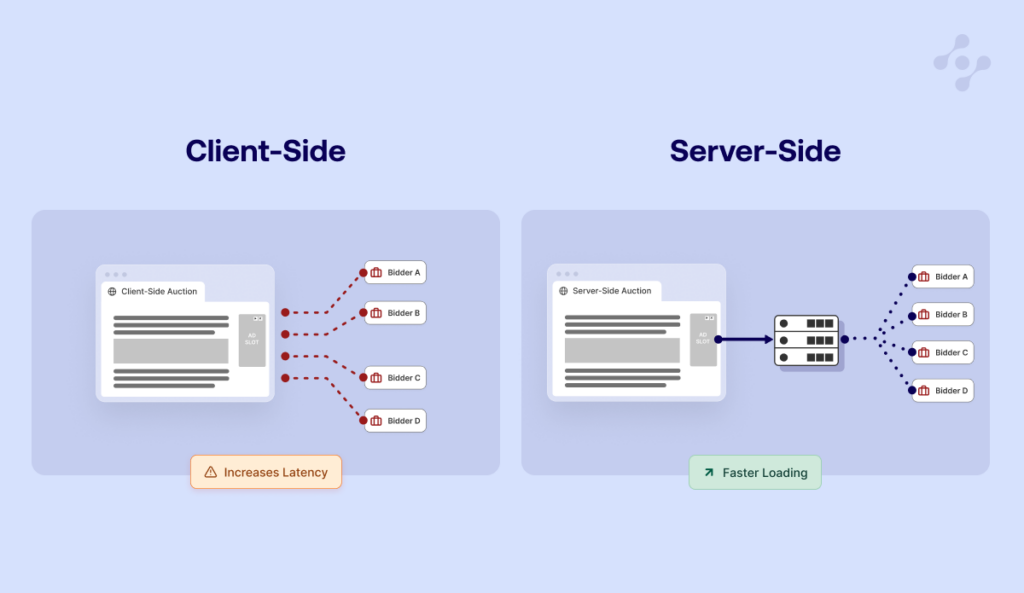
Client-side header bidding runs auctions in the browser. It can support strong match rates, but adding too many browser-side calls can increase latency.
Server-side header bidding moves more of the auction process away from the browser. This can reduce page weight and support faster loading, but publishers need to monitor how it affects match rates, bid density and demand performance.
Hybrid header bidding combines both models. It gives publishers more flexibility to balance demand competition, speed and auction quality.
For publishers focused on programmatic revenue optimization, this balance matters. The best architecture is not always the one with the most demand partners. It is the one that creates the best combination of competition, speed and measurable revenue impact.
Control Becomes Critical as the Ad Stack Scales
As publishers grow, monetization becomes harder to manage manually.
Teams need to handle demand partners, direct campaigns, floors, layouts, refresh rules, formats, consent signals, markets, devices and performance issues. When these decisions are spread across too many tools, optimization becomes slower and less precise.
A strong ad management platform for publishers should help teams:
- manage demand partners from one place;
- test new configurations safely;
- adapt rules by site, page type, device or geography;
- control ad density and refresh behavior;
- monitor direct and programmatic performance;
- centralize revenue, reporting and operational visibility;
- reduce repetitive AdOps work.
Control does not mean doing everything manually. It means having the right level of visibility and configuration to make better decisions, faster.
Revenue Data Needs to Explain What Changed
Publishers need answers.
If revenue drops, teams need to know whether the cause is traffic, viewability, bid density, latency, floor pricing, a demand partner issue, a page type, a device, a geography or a consent change.
This is where ad revenue analytics becomes essential.
Useful analytics should help publishers understand:
- which pages generate the strongest Page RPM;
- which bidders add incremental value;
- where latency is affecting monetization;
- which formats improve revenue without damaging UX;
- which traffic sources monetize best;
- where floor prices are too high or too low;
- what changed before a performance drop.
As wrapper platforms become broader monetization operating layers, analytics are no longer just a reporting feature. They are part of how publishers understand whether the setup is actually improving revenue, speed and demand quality.
Without this level of visibility, publishers can see that performance changed, but not what to do next.
What to Look at Before Choosing a Wrapper
Before choosing a header bidding wrapper, publishers should evaluate the platform across several criteria.
1. Ad delivery speed
The wrapper should help ads load quickly and efficiently. Faster ad delivery can support stronger viewability, better UX and higher revenue opportunities.
2. Auction architecture
Publishers should understand whether the platform supports client-side, server-side or hybrid auctions, and how that model affects demand competition and latency.
3. Demand partner management
The platform should help publishers understand which partners bring incremental value and which ones add noise, latency or duplicated demand.
4. Testing and configuration
A strong platform should allow teams to A/B test layouts, demand partners, floors and formats without relying on long development cycles.
5. UX safeguards
The wrapper should support lazy loading, in-view refresh, ad density control, layout stability and Core Web Vitals protection.
6. Revenue intelligence
Publishers need visibility into Page RPM, bidder performance, viewability, latency, traffic sources, geographies and content-level monetization.
7. Operating model
Publishers should understand whether the platform is fully managed, self-serve, hybrid or infrastructure-led. This affects how much control the team keeps, how much support they receive and how quickly they can act on optimization opportunities.
8. Support
Publishers should evaluate whether the platform comes with onboarding support, strategic guidance and ongoing optimization..

Header Bidding Wrapper Platform Comparison
1. Ad Manager Hub
Best for: publishers looking for a lightweight, high-control wrapper that combines speed, hybrid header bidding, analytics, testing and expert support.
Ad Manager Hub is positioned as a premium monetization wrapper for digital publishers and media groups that want to maximize yield while balancing site speed, user experience and long-term audience trust.
The platform is built around an ultra-light 300KB infrastructure and a unified optimization layer that brings together real-time analytics, A/B testing, dynamic floor pricing, premium ad formats and expert guidance.
Where Ad Manager Hub fits
Ad Manager Hub gives teams a full operating layer for publisher monetization, combining technology, analytics, control and strategic support.
The platform supports:
- hybrid client-side and server-side header bidding;
- fast ad delivery;
- smart lazy loading;
- in-view refresh;
- dynamic floor pricing for publishers;
- A/B testing;
- premium ad formats;
- real-time analytics;
- configuration UI;
- expert AdOps, tech and customer success support.
Ad Manager Hub unlocks omnichannel inventory value, enhances both programmatic and direct revenue, delivers ads 2 to 3 times faster, drives strong revenue uplift and reduces operational complexity.
2. Freestar
Best for: publishers looking for a managed monetization partner with header bidding, optimization technology and operational support.
Freestar positions itself as a fully managed monetization partner rather than just a standalone wrapper provider. Its offer combines a unified monetization platform, AI-powered optimization technology, a fast Prebid wrapper, dynamic flooring, transparent reporting, streamlined payments and a dedicated team handling demand partner management, ad quality and troubleshooting.
This can make Freestar relevant for publishers that want to reduce internal AdOps workload and rely on a more outsourced operating model.
Where Freestar can fit
Freestar can be a good option for publishers looking for a white-glove service model, especially if they want monetization support across multiple environments such as web, app, or AMP.
What publishers should evaluate
Publishers should clarify how much control they retain over bidder configuration, testing, reporting granularity, floor strategy and long-term optimization decisions. A managed model can simplify operations, but some publishers may want more direct control over how their ad stack evolves.

3. Aditude
Best for: publishers looking for unified programmatic infrastructure across wrapper, server-side bidding, analytics and financial reporting.
Aditude offers includes Cloud Wrapper, Prebid Server, Insights, Exec and app monetization infrastructure. The value proposition is built around reducing development dependency, automating operational overhead and giving publishers control without vendor lock-in or revenue share.
This makes Aditude relevant for publishers with technically mature teams that want flexible infrastructure and more control over how their monetization stack is deployed and managed.
Where Aditude can fit
Aditude can be useful for publishers that want cloud wrapper infrastructure, managed Prebid Server capabilities, advanced analytics and stronger internal control over monetization operations.
What publishers should evaluate
Publishers should evaluate how the setup affects match rates, reporting depth, demand performance and optimization workflow. A strong infrastructure layer still needs to translate into measurable revenue outcomes and a manageable day-to-day operating model.
4. Assertive Yield
Best for: publishers looking for a broader monetization platform that combines wrapper management, revenue intelligence and operational optimization.
Assertive Yield can fit publishers looking for a broader monetization operating layer with strong analytics, testing and optimization capabilities. Its wider platform positioning also includes elements such as yield intelligence, traffic shaping and support for more efficient auction management.
This makes Assertive Yield relevant for publishers that want deeper control and visibility across monetization.
Where Assertive Yield can fit
Assertive Yield can fit publishers that want a modern monetization operating layer with strong analytics and optimization visibility, especially if they are reviewing legacy setup complexity and looking for a more connected approach.
What publishers should evaluate
Publishers should evaluate how much of the setup is actively managed, how much direct control the team retains, how easy it is to test and deploy changes, and whether the platform gives them enough operational support to turn visibility into action.
Where Ad Manager Hub Goes Further Than a Standard Wrapper
The difference is not only that Ad Manager Hub runs header bidding. The difference is that it connects the layers publishers need to optimize monetization properly.
Revenue issues rarely come from one isolated factor. They are usually connected to several variables at once: slow ad delivery, bidder overlap, weak floor logic, poor viewability, heavy scripts, fragmented data and manual operations.
Ad Manager Hub is designed to bring those layers into one operating model.
It helps publishers:
- carry out ad stack optimization;
- strenghten ad yield optimization;
- support supply path optimization for publishers;
- protect Core Web Vitals;
- simplify operations;
- understand Page RPM and auction performance;
- test changes safely;
- manage monetization across Web, AMP and In-App environments.
Faster Ads Create More Valuable Impressions
Speed is one of the clearest differentiators of Ad Manager Hub.
Internal benchmarks show that publishers using the platform deliver significantly more first ad requests in under two seconds and far fewer slow first ad requests above four seconds compared with heavier ad stack setups.
This matters because faster ad delivery increases the chance that ads are actually seen. That supports viewability, stronger eCPMs, more revenue opportunities, better UX and healthier Core Web Vitals.
For publishers, wrapper speed becomes commercial performance. The faster the ad stack can request and render ads without damaging UX, the more value publishers can capture from existing traffic.
Conclusion
Choosing a header bidding wrapper is one of the most important decisions publishers will make in their monetization strategy.
Freestar, Aditude and Assertive Yield each address the challenge from a different angle. Freestar supports publishers looking for a managed monetization partner. Aditude offers unified programmatic infrastructure across wrapper, server-side bidding and reporting. Assertive Yield combines wrapper management with revenue intelligence and operational optimization.
But for publishers looking for a complete header bidding optimization platform that brings together speed, hybrid auctions, ad revenue analytics, A/B testing, dynamic pricing, UX safeguards and expert support, Ad Manager Hub offers a stronger path.
The right wrapper should not add more complexity. It should help publishers build a cleaner stack, improve programmatic revenue optimization, protect the audience experience and make ad revenue optimization easier to act on every day.
FAQs
A header bidding wrapper is the technology layer that manages bid requests from multiple demand partners before the ad server makes its final decision. It helps publishers increase auction competition and capture more value from each impression.
Publishers should look for a header bidding optimization platform that combines fast ad delivery, hybrid auctions, demand partner control, A/B testing, UX safeguards and ad revenue analytics. These capabilities help publishers optimize revenue without adding unnecessary complexity.
A wrapper supports publisher monetization by increasing competition for ad inventory, improving auction efficiency and helping publishers capture more value from each pageview. The strongest wrappers also support ad stack optimization and provide clear performance data.
Ad Manager Hub helps publishers improve programmatic yield through hybrid header bidding, faster ad delivery, dynamic price flooring, smart lazy loading, in-view refresh, A/B testing and granular analytics in one platform.