

Publisher monetization stacks have become heavier over time.
More demand partners, scripts, wrappers, placements, refresh rules and formats can create new revenue opportunities. However, they can also make the setup slower, harder to manage and more difficult to optimize.
For publishers, this creates a practical challenge. Revenue teams need flexibility, but they also need a monetization setup that protects site speed, user experience and long-term audience trust.
The stronger question is how publishers can reduce ad stack complexity while protecting revenue potential.
This is where ad stack optimization becomes essential. Publishers need to understand which parts of the stack create value, which ones slow performance and which rules need better control.
Why Ad Stack Complexity Becomes a Revenue Problem
Ad stack complexity usually grows gradually.
A new bidder is added to increase competition. A new format is introduced to improve yield. A new placement is tested. A refresh rule is adjusted. A script is added for analytics, consent, measurement or troubleshooting.
Each decision may make sense on its own. Over time, the full stack becomes harder to understand.
This matters because revenue depends on more than demand volume. Speed, viewability, auction setup, placement quality and page experience all influence performance. A setup can look strong because it includes many partners or formats, but still lose value if it slows the page or makes optimization harder.
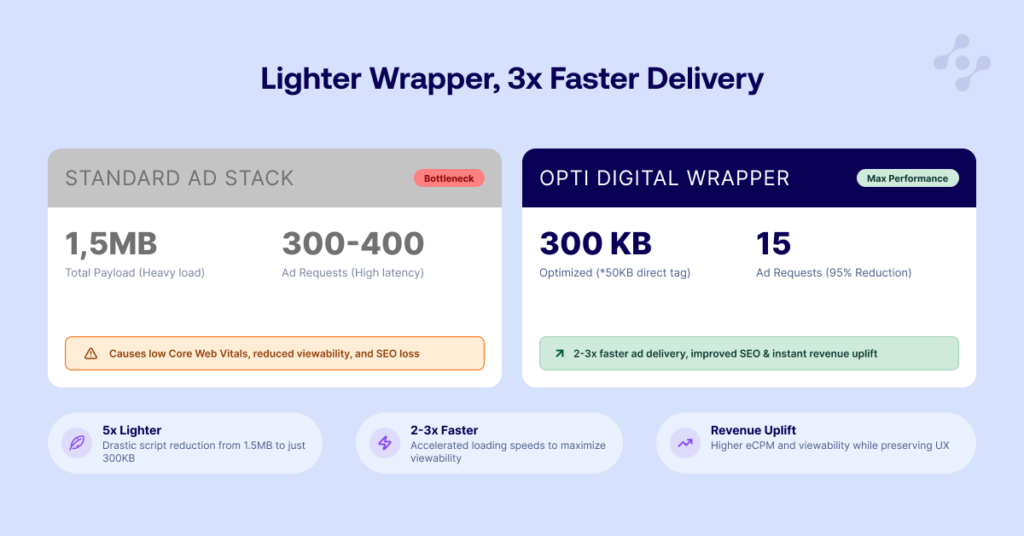
The difference can be significant. A non-optimized standard ad stack can involve 300 to 400 requests and around 1.5MB of script weight, while an optimized setup can reduce this to around 15 requests and 300KB.
This level of ad stack optimization matters because faster ad delivery can directly affect monetization performance. Google’s Fast Ads Matter study, based on 4 billion impressions, found that adding just one second of delay before an ad response resulted in 1.1% fewer impressions and 3.6% lower mobile viewability. Reducing unnecessary scripts, requests and latency can therefore help publishers protect viewability, monetizable impressions, Core Web Vitals and overall user experience.
With Ad Manager Hub, publishers can approach ad stack optimization from a lightweight technical foundation designed to deliver ads 2 to 3x faster. By reducing the latency that Google’s research shows can negatively affect impressions and viewability, publishers can create stronger conditions for inventory performance and revenue opportunities while also reducing operational complexity.
Why More Tools Do Not Always Mean More Control
Publishers often use different systems for different parts of monetization: header bidding, ad serving, refresh, formats, demand partners, consent and reporting.
Each tool may solve a specific problem. The difficulty starts when decisions are spread across too many places.
This matters because revenue teams need to connect technical changes with revenue and UX impact. Which bidder is adding value? Which placements are slowing the page? Which refresh rules improve revenue without weakening inventory quality? Which changes affect user experience?
When the answers are hard to connect, optimization slows down.
This is where an ad management platform for publishers becomes useful. It should help teams manage the operational layer of advertising with more clarity, from wrapper configuration to placement rules and ad delivery.
Ad Manager Hub combines control, insights, A/B testingc apabilities, and AI expert guidance in a single operating layer, helping publishers reduce fragmentation without limiting their ability to optimize revenue.
Where Header Bidding Optimization Fits
Header bidding can strengthen auction competition, but it needs careful management.
Each bidder, timeout rule, wrapper configuration and auction setting can affect performance. A bidder may create value in one market or format, but add latency somewhere else. A timeout that is too short may limit competition. A timeout that is too long may slow down ad delivery.
This matters because header bidding performance affects both revenue and page experience. A stronger auction is only useful if ads still load efficiently and inventory quality is protected.
Header bidding optimization for publishers is an ongoing practice. Teams should understand which bidders contribute revenue, where latency affects performance and how auction settings change by device, market or placement.
A faster, lighter wrapper helps protect that balance.
Ad Manager Hub supports this work through fast ad delivery, configuration controls and expert guidance across AdOps, Tech and Customer Success.
Why Wrapper Weight Matters
The wrapper is one of the most important technical layers in publisher monetization.
It controls how demand partners are called, how auctions are managed and how ads are delivered to the page. If the wrapper is too heavy, it can affect latency, viewability, Core Web Vitals and user experience.
This matters because technical performance and revenue performance are closely connected. A slow ad setup can delay rendering, reduce viewability and weaken the value of inventory. Even strong demand may not create full value if ads are delivered too slowly or in poor conditions.
A lighter wrapper helps publishers reduce unnecessary technical weight and create better conditions for monetization. It also makes the stack easier to manage, optimize and troubleshoot.
Ad Manager Hub is built around a 300KB optimized stack and 50KB direct tag footprint. Faster ad delivery can increase impression volume, improve viewability, strengthen eCPMs and support revenue growth.
How Smarter Loading and Refresh Protect Inventory Quality
Not every served impression creates the same value.
An ad may be delivered, but if it loads too early, appears too far from the reader’s attention or refreshes before it has a real opportunity to be seen, inventory quality can suffer.
This matters because inventory quality affects both advertiser confidence and long-term monetization. More impressions are not always better if they weaken viewability or user experience.
A better setup uses ad delivery rules that reflect user behaviour and page context. Lazy loading helps call ads when they are more likely to become viewable. Refresh can support revenue when it is based on the right conditions.
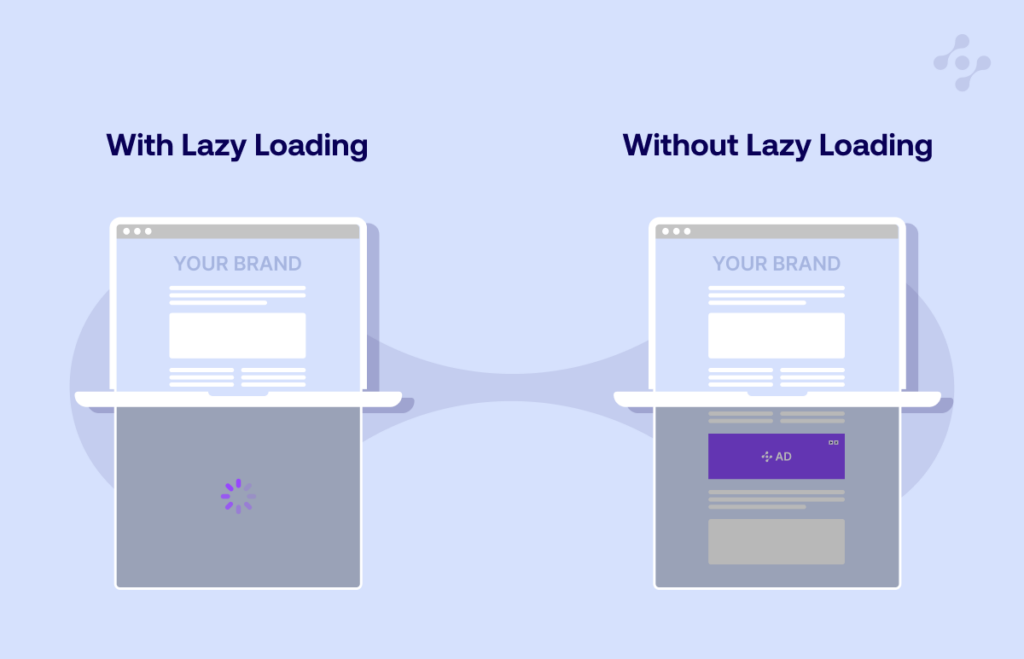
A stronger ad management platform for publishers should help teams manage these rules with precision.
Ad Manager Hub helps publishers control loading and refresh logic through an intuitive configuration UI, making it easier to activate, test and adjust advanced setups without heavy technical work.
What Publishers Should Expect From a Modern Ad Management Platform
Publishers need technology that helps them manage monetization with more control, not more operational noise.
A modern ad management platform for publishers should support header bidding optimization for publishers, ad stack optimization, loading and refresh controls, placement management and an ad server optimization checklist.
This matters because revenue teams need to understand how technical decisions affect performance. Which placements perform best? Where is latency affecting revenue? Which refresh rules protect inventory quality? Which formats should be tested? Which configurations are worth scaling?
The strongest setup gives publishers a clearer operating layer for monetization.
Conclusion
Publisher monetization has become too complex to manage through disconnected decisions.
Revenue teams need control over wrapper performance, auction setup, ad delivery, placements, refresh, ad server logic and user experience. When these elements are managed separately, publishers may have tools in place, but not enough clarity to optimize them together.
A modern ad management platform for publishers should help teams reduce ad stack complexity, improve technical performance and make better monetization decisions.
Ad Manager Hub helps publishers manage this foundation through faster ad delivery, a unified optimization layer and a more controlled approach to ad stack optimization.
To learn how Ad Manager Hub can support your monetization setup, contact us.
FAQs
An ad management platform for publishers helps publishers manage and optimize the operational side of advertising monetization, including wrapper configuration, ad delivery, placement rules, refresh, demand integrations and ad server coordination.
Wrapper weight matters because it can affect ad delivery speed, latency, viewability, Core Web Vitals and user experience. A lighter setup helps publishers create better conditions for monetization.
Ad Manager Hub supports ad stack optimization with a 300KB optimized stack, 50KB direct tag footprint, configuration controls, analytics, A/B testing, dynamic price flooring and expert guidance for continuous optimization.