ad operations services
When a small publisher team spreads ad operations services across commercial, editorial and technical roles, routine trafficking can crowd out revenue planning. The answer is not automatically to outsource everything: first separate decisions that require publisher knowledge from repeatable operational work.
Key Takeaways
- Separate publisher-specific decisions, such as revenue planning, from repeatable trafficking tasks before deciding what to outsource.
- Outsourcing works best for routine operational work, while strategic choices usually stay in-house where team context matters.
- When commercial, editorial and technical roles share ad operations duties, the risk is that daily tasks crowd out planning.
- A clear split of responsibilities helps small teams protect time for testing and yield decisions.
- Before outsourcing anything, audit which tasks require internal knowledge and which follow repeatable processes.
Ad operations connects inventory, campaigns and demand systems, making it a core part of a publisher’s broader ad revenue optimization strategy. A practical division keeps commercial direction with your team while assigning specialist execution where it adds capacity.
What Ad Operations Services Cover for a Publisher
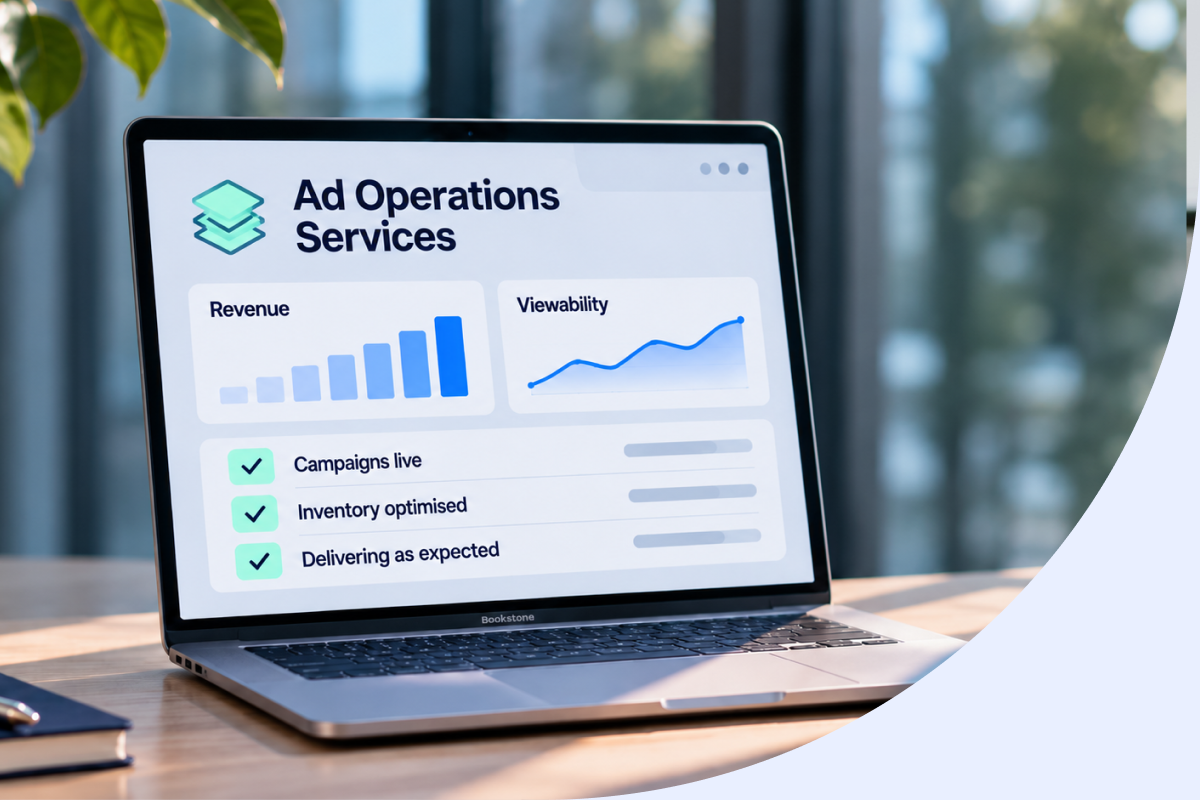
Ad operations is the work that turns a publisher’s advertising strategy into functioning campaigns and measurable inventory. It covers campaign trafficking and scheduling, yield management, reporting, deal checks, ads.txt and consent coordination, plus quality monitoring.
In the programmatic chain, the ad server manages delivery and line items, while a header bidding optimization platform organises bidding and SSPs connect inventory to demand through exchanges. Ad operations helps these components work together, checks that campaigns serve as intended and investigates discrepancies or delivery issues.
The work has commercial consequences. If nobody owns pacing checks, deal delivery or changes to Google Ad Manager configuration, a problem may remain unnoticed while it affects campaign commitments or available inventory.
Our consultancy begins with a broader ad stack optimization audit covering site and app layouts, Google Ad Manager configuration, Unified Pricing Rules, direct campaigns, formats, demand and wrapper architecture. We also assess formats and placements, refresh and lazy-loading rules, wrapper architecture, SSP selection and inventory targeting before implementation decisions are made.
For a lean team, the useful distinction is between policy and execution. Your team can define business priorities and acceptable trade-offs, while operational support handles recurring checks and technical changes within agreed boundaries.
Keep or Outsource: A Task-by-Task Decision Framework
Decide task by task rather than treating the whole function as one package. For each activity, consider how often it occurs, the revenue or delivery consequence of an error, and how much tacit knowledge of your own platforms it requires.
Keep decisions close to the people accountable for commercial outcomes. Strategy, pricing policy and relationships with advertisers or demand partners depend on your business priorities; diagnostics, configuration, trafficking, quality assurance and routine monitoring are more readily assigned to a specialist under clear approval rules.
| Task | Typical owner | Decision to retain |
|---|---|---|
| Revenue strategy and pricing policy | Publisher team | Business goals, risk tolerance and pricing direction |
| Advertiser and demand relationships | Publisher team | Commercial terms and relationship priorities |
| Diagnostics and configuration | Specialist support, with approval | Changes that affect inventory or delivery |
| Trafficking, QA and daily monitoring | Specialist support or shared team | Escalation thresholds and campaign commitments |
| Consent, ads.txt and policy duties | Publisher accountable, with operational support as agreed | Responsibility for compliance and publisher decisions |
Frequency alone is not enough to decide. A recurring task with a high revenue consequence may suit specialist execution, but only if the operator has documented access, escalation routes and a reliable record of changes.
Conversely, a task that occurs less often may still belong in-house when it relies on knowledge of direct deals, audience priorities or a publisher’s pricing appetite. If day-to-day checks regularly displace strategy work, ad operations outsourcing can add capacity while helping publisher teams stay focused on programmatic revenue optimization and commercial priorities.
Choosing a Delivery Model: In-House, Outsourced or Co-Sourced
The right operating model depends on how much control your team needs, whether specialist capacity is available when required, and how concentrated platform knowledge is among staff. Outsourcing can add expertise without a permanent hire, while an in-house team keeps daily decisions close to the business. Co-sourcing combines publisher oversight with external operational support.
| Model | Control | Cost flexibility | Specialist depth | Key-person risk |
|---|---|---|---|---|
| In-house | Direct control over priorities and changes | Staffing costs continue as workload changes | Depends on the skills and capacity you can recruit | Knowledge may sit with one or two employees |
| Outsourced | Set through scope, approvals and account permissions | Can provide access to support without hiring a full team | Can bring experience across configuration and operations | Depends on documentation and handover arrangements |
| Co-sourced | Publisher retains policy and approval boundaries | Support can be matched to agreed responsibilities | Combines internal context with external expertise | Shared records reduce reliance on one individual |
For many publishers, co-sourcing is a practical middle path within a broader publisher monetization strategy: your team retains commercial direction, while specialists handle delivery issues, approved changes and routine monitoring. Our service model includes consultancy, implementation and ongoing support; its audit work reviews site and app layouts, Google Ad Manager configuration, Unified Pricing Rules and direct campaign setup before implementation is planned.
Before work begins, agree access levels for Google Ad Manager, including who can view, edit or approve changes to yield groups, line items and other settings. Define service levels, escalation routes, expected response times and the change-log details required for each adjustment.
Make documentation handover part of the agreement, covering account configuration, wrapper architecture, operating procedures and unresolved issues. Specify who manages consent, ads.txt and platform-policy duties, and set exit terms for access removal, data transfer and continuity of service. Clear governance lets you use external expertise without surrendering accountability for your advertising business.
Measuring an Ad Operations Arrangement
Judge the arrangement by whether it supports reliable delivery and informed revenue decisions, not by hours billed. Set a baseline before work begins, using comparable periods and noting changes in traffic, inventory, demand or campaign mix that could affect the results.
| Measure | What it indicates | How to use it |
|---|---|---|
| Revenue per thousand impressions | Revenue movement across a defined inventory scope | Compare like-for-like periods and account for changes in traffic or demand. |
| Deal fill | Whether eligible deal impressions are being served | Review delivery against campaign requirements and investigate missed opportunities. |
| Discrepancy rates | Differences between reporting systems | Track recurring gaps and identify where reconciliation is needed. |
| Time to fix | How quickly reported issues reach resolution | Set expectations by issue severity and record the escalation path. |
| Change-log quality | Whether adjustments are traceable and understandable | Check that each entry records the change, date, reason and approval. |
Agree targets after reviewing your baseline and operational priorities. For example, a publisher may prioritise faster resolution of delivery faults before setting a revenue target, since revenue movement can reflect factors beyond the operator’s control.
Review the measures on a regular schedule using an ad revenue analytics platform that connects revenue, delivery and operational changes, giving teams a clearer basis for optimization decisions.
Compliance responsibilities remain with the publisher, including consent, ads.txt and platform-policy duties, whoever holds Google Ad Manager access. Keep those obligations explicit in the operating agreement and access controls.
Frequently Asked Questions
What are ad operations services, and what tasks do they cover for a publisher?
Ad operations services support the execution of a publisher’s broader publisher monetization platform strategy by turning advertising plans into functioning campaigns, measurable inventory and ongoing optimization. They cover campaign trafficking and scheduling, yield management, reporting, deal checks, ads.txt and consent coordination, plus quality monitoring across the ad server, wrapper and SSP chain.
What is the difference between ad operations services and ad operations outsourcing?
Ad operations services describe the operational work itself, such as trafficking, monitoring and configuration. Outsourcing is one delivery choice: it assigns that work to an external specialist while your team keeps commercial direction, pricing policy and advertiser relationships in-house.
Which ad ops tasks should a publisher keep in-house and which should be outsourced?
Keep strategy, pricing policy and advertiser or demand partner relationships in-house, because they depend on your business priorities. Diagnostics, configuration, trafficking, quality assurance and daily monitoring can go to specialist support, provided you agree approval rules, access levels and escalation routes first.
How much does a publisher ad ops team cost compared with an outsourced service?
An in-house team carries continuous staffing costs even when workload falls, while an outsourced service can be matched to agreed responsibilities and scales with need. The trade-off is control: outsourcing sets daily decisions through scope and approvals, so governance matters as much as price.
When is the right moment to outsource ad operations rather than hire another member of staff?
Outsourcing suits the point when routine checks and trafficking regularly displace strategy work, but you do not need a permanent hire. It also fits when platform knowledge sits with one or two employees and specialist capacity is only needed at certain times.
What governance should a publisher agree before outsourcing ad operations?
Agree access levels in Google Ad Manager, service levels, escalation routes and the change-log details required for each adjustment. Documentation handover should cover account configuration, wrapper architecture and unresolved issues, with clear ownership of consent, ads.txt and platform-policy duties plus defined exit terms.
What is co-sourced ad operations, and why do publishers choose it?
Co-sourcing combines publisher oversight with external operational support: your team retains policy and approval boundaries while a specialist handles delivery investigations, approved changes and routine checks. Many publishers choose it because it adds specialist capacity without transferring commercial ownership or concentrating knowledge in one individual.