
prebid amp
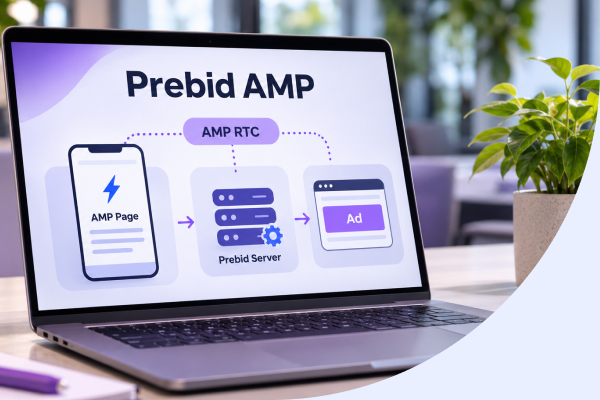
Prebid AMP is a way to request server-side bids for AMP ad slots, because AMP pages do not allow the user-generated JavaScript that Prebid.js needs to run in the browser. For publishers, the key question is how AMP Real-Time Config (RTC) can connect an ad request to supported server-side demand.
Key Takeaways
- AMP pages cannot run Prebid.js because AMP restricts custom JavaScript, so header bidding for these slots happens server-side instead.
- AMP Real-Time Config acts as the bridge between your ad requests and supported server-side demand sources.
- Configuring RTC correctly determines which demand partners actually compete for your AMP inventory.
- Publishers should treat AMP monetisation as a separate setup from their main wrapper, since the technical path differs entirely.
That route can preserve header bidding on AMP inventory, but it does not offer the same bidder availability as a page running Prebid.js. Understanding the request flow helps distinguish an architectural limit from a setup fault.
Why Prebid.js Cannot Run on AMP Pages
AMP restricts custom JavaScript, so a client-side Prebid.js wrapper cannot run on an AMP page. Instead, AMP RTC can send an ad request to a server-side bidding service, such as Prebid Server, which can return targeting data for the ad slot.
AMP RTC and the rtc-config Attribute
AMP RTC, or Real-Time Config, lets an AMP ad request fetch configuration from a remote endpoint. The rtc-config attribute on an amp-ad element specifies that request, including settings used to route it towards server-side bidding.
For Prebid Server, the AMP request is served through the /openrtb2/amp endpoint. A tag_id identifies the ad placement to the server; it is not a bidder name or a replacement for the ad slot’s own configuration.
Anatomy of an amp-ad Tag with rtc-config
This simplified example shows the relationship between the ad slot and its RTC configuration. Exact attributes and endpoint details depend on the implementation.
<amp-ad
  type="doubleclick"
  data-slot="/1234/article"
  rtc-config='{"urls":["https://server.example/openrtb2/amp?tag_id=placement-1"]}'>
</amp-ad>
The Revenue and Demand Trade-off on AMP Inventory
AMP RTC and Prebid Server support a narrower set of bidders than Prebid.js on a canonical page. Prebid Server documentation describes overlap between the available bidders, but not identical coverage. Fewer eligible demand partners on AMP can therefore reflect the architecture, rather than a configuration mistake.
That difference can reduce the number of bids competing for an impression, which may affect yield. The practical impact depends on which partners serve your audience and inventory; bidder count alone does not establish whether AMP placements are performing well.
Targeting data may also be more limited than on a page where client-side code can gather and pass additional signals. The trade-off is between retaining an AMP-specific route to server-side demand and accepting its supported-bidder and data constraints.
Choosing an AMP Bidding Architecture: Native RTC, Self-Hosted Prebid Server or Managed Demand
Choose an approach based on the level of control your team can support, the demand partners available for AMP, and how consent information will be handled. Native RTC configuration, a self-hosted Prebid Server and managed demand can all support server-side requests, but they differ in ownership and operational workload.
| Approach | Control | Bidder reach | Maintenance | Consent handling |
|---|---|---|---|---|
| Native RTC endpoint | Depends on the endpoint and configuration available to you. | Limited to the demand supported by that service. | Less server ownership, with less control over its internal operation. | Confirm how the endpoint receives and processes consent signals. |
| Self-hosted Prebid Server | Greater control over deployment and configuration. | Limited to adapters and bidders supported by the server setup. | Your team manages hosting, upgrades, security and adapter changes. | Your implementation must pass consent information through the request flow. |
| Managed demand | Some operational choices sit with the service provider. | Depends on the demand and integrations the service supports. | Can reduce direct server operations, while requiring coordination with the provider. | Check responsibilities for signal transmission and compliance configuration. |
Self-hosting Requirements and Vendor Registration Versus a Direct Server URL
Self-hosting suits teams prepared to operate a server-side service as part of their ad stack. Prebid Server’s repository documents release and security maintenance, including validation relating to bidder adapters with dynamic hostnames. That ongoing work matters when estimating ownership, not just the initial deployment.
For AMP RTC, a callout-vendors.js registration can identify an approved vendor configuration, while a direct Prebid Server URL routes the request to an endpoint you operate or are authorised to use. Confirm which route your AMP setup supports and how each handles consent before choosing; the URL alone does not establish bidder availability.
What a Managed Wrapper Adds for AMP Pages
A managed option may reduce the server operations your team handles, but it does not remove the need to verify supported bidders, request routing and consent responsibilities. With Demand Hub, our server-side demand is provided through a Prebid bid adapter. It complements a header bidding wrapper; it does not replace one or independently remove AMP’s client-side restrictions.
Use a short decision check before proceeding: identify who operates the endpoint, confirm the required bidders are supported, assign responsibility for upgrades and security, and document how consent signals reach the auction. For implementation details, use our integration guide rather than treating the architecture decision as a setup specification.
Measuring AMP Revenue and Meeting Consent Obligations
To assess prebid amp revenue, trace each step from the AMP ad request to the final impression and revenue record. Prebid Server documentation describes AMP requests reaching the /openrtb2/amp endpoint with a tag_id; a successful request alone does not confirm that a bid was returned, applied to the ad slot or monetised.
A diagnostic checklist for verifying AMP bid requests generate net revenue
Use a consistent reporting window and compare AMP placements with suitable non-AMP inventory, accounting for differences in traffic and page context. Check the request path in order:
- Confirm the AMP ad request reaches the intended endpoint and identifies the expected placement.
- Check server responses for errors, time-outs and returned bids from supported demand.
- Verify that bid targeting is passed back to the ad request and that the ad server records the resulting impression.
- Reconcile impressions, fill and net revenue across the server, ad server and publisher reporting.
If requests return bids but revenue does not follow, investigate targeting transfer, ad-server delivery and reporting alignment before changing demand settings. Insights Hub provides publisher revenue analytics for wider ad revenue optimisation; results depend on your inventory, traffic and implementation.
GDPR and CCPA consent flow through AMP RTC
Consent must be considered across the full request path, not only at the page level. Check that your consent platform gathers the applicable choice, that AMP RTC passes the relevant signal to the server-side endpoint, and that the endpoint and participating demand process it according to your requirements.
Document who configures and monitors each hand-off, including any vendor registration or server settings. Validate the flow in the regions and scenarios relevant to your audience, and involve your privacy team where interpretation of GDPR or CCPA obligations is needed.
Frequently Asked Questions
How should consent information be handled with AMP server-side bidding?
Consent signals must reach the server-side auction for compliant bidding, and responsibility depends on your architecture. With a native RTC endpoint, confirm how it receives and processes consent; with self-hosted Prebid Server, your implementation must pass consent through the request flow; with a managed provider, document who handles signal transmission and compliance configuration.